
It is one of the most essential components in modern application architecture. It serves as a key entry point for clients to access back-end services and APIs. Instead of having clients communicate directly with every service. API Gateways can be utilised in various solutions, including microservices, cloud-based applications, enterprise applications, and IoT solutions. They help ensure security in API management and provide a centralised look at the traffic itself.
What Is an API Gateway?
An API Gateway is a software application or service that acts as an intermediary between the clients and back-end servers. It receives the requests from the client and forwards them to the respective service.
Why Do Businesses Need API Gateways?
As an organisation uses different applications, services, databases, and possibly other third-party providers, it will be handy to have proper communication. Through the use of API gateways, companies can maintain their operations standardised. This is achieved by establishing an effective manner of securing, controlling, managing, and gaining insight into their API usage.
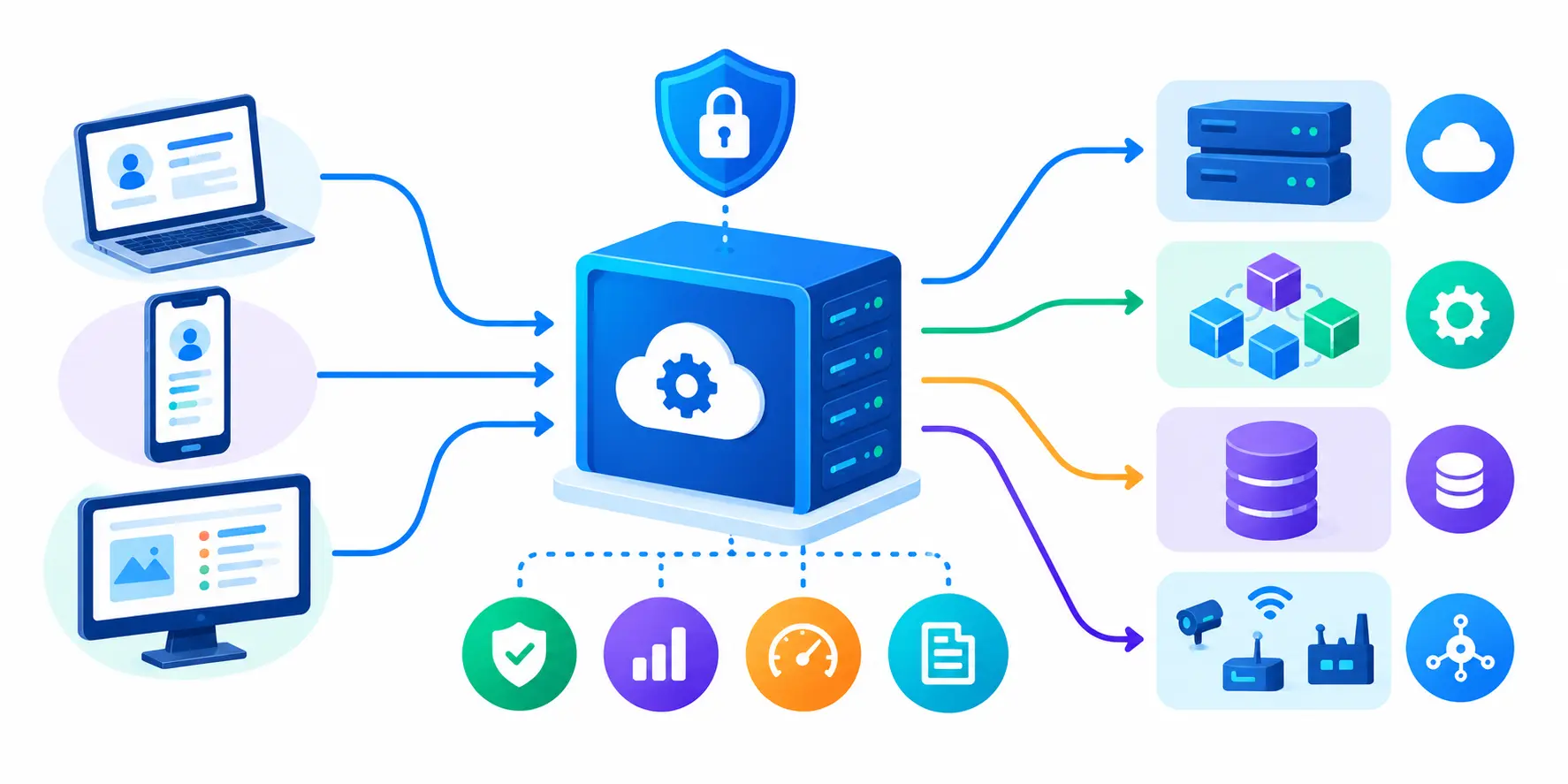
How does an API Gateway work?
An API gateway works in a request-response mode. In doing so, if a request is directed to an API, it is received, and appropriate processing is performed.
Requests Routing
API gateways can also perform the function of request routing. It implies analysis of an incoming request and making decisions regarding the backend service appropriate to be in charge of request processing. For instance, requests related to customers may get routed to customer service while requests about orders may get routed to order service.
Authorisation and Authentication
API gateways can provide a single security layer for APIs. It allows authentication of clients with the help of API keys, tokens, and so on. The authorisation policy specifies the rights and restrictions of authenticated clients in relation to resources and the operations they are allowed to perform.
Response Processing
After the backend has dealt with the request, the response is sent to the API gateway to forward it to the client application. It also allows changing the response format, collecting responses from different services, and applying other policies to provide the final answer.
Main Advantages of an API Gateway
The main advantage of API gateways is consolidating API traffic. This works out well with more complicated apps and more services being used.
Enhancing Security
With the help of an API gateway, it becomes possible to combine different capabilities associated with authentication, authorisation, access control, and related issues, creating a safe environment that clients have to deal with while accessing the backend.
Scaling and Performance
When an application’s traffic levels rise, more requests will need to be catered to than those the backend services can handle. The utilisation of an API gateway will serve the needs of such requests by making requests more efficient and using traffic management methods.
Centralized API Management
If API gateways are not used in an organisation, API traffic may be spread across several systems and infrastructure elements. Being guided by API gateways will allow an organisation to create one unified layer and control its APIs.
Common API Gateway Use Cases
This element is particularly relevant in cases when there are a number of systems or services that need communication handling.
Microservices Architecture
One example is microservices architecture, which consists of numerous independent microservices. Hereby, a given mobile/web application may need information from various microservices at once.
Enterprise Application Integration
Another example is a big enterprise with many diverse applications, legacy systems, APIs, and third-party solutions. The API gateway creates a communication layer among these systems in this regard.
Cloud and IoT Applications
Cloud services could be numerous across different platforms or environments. The API gateway can act as an access layer for the services to regulate API traffic. IoT uses API gateways also in order to facilitate the communication between connected devices.
API Gateway Vs Reverse Proxy and Load Balancer
API gateway, reverse proxy, and Load Balancer have similar tasks but use various approaches, and that’s why they share certain features. The reverse proxy operates on the front end of back-end servers, which means that it forwards requests of the clients to servers and manages the way of requests are made, making it work as a load balancer.
API Gateway vs. Reverse Proxy
The reverse proxy responds to requests, which means that it accepts requests on behalf of back-end servers and routes them to the proper place. The functions of a reverse proxy include TLS termination, caching, routing, and traffic management, whereas an API gateway is capable of performing all these functions, but it goes further with its features directed towards API management.
API Gateway Vs. Load Balancer
The load balancer is responsible for receiving incoming traffic from users and dispersing it to different back-end servers or service setups. It is mainly used to enhance availability, manage incoming traffic, and optimise resources.
The API Gateway has a similar function, but the main difference is that it takes care of the distribution and direction of the traffic, as well as understanding the type of requests.
Popular API Gateway solutions
There are choices for businesses to opt for cloud API management services and tools, including on-site solutions.
Amazon API Gateway, Azure API management, and google cloud API Gateway
Amazon API Gateway, Microsoft Azure API Management, and Google Cloud API Gateway are cloud-based offerings created to aid organisations in orchestration, development, preservation, monitoring, as well as management of the API they design.
Kong and NGINX
Kong is an API gateway management solution for SOA and other distributed environments with features like traffic handling, authentication, plugins, etc.
How to choose the right API Gateway
Choosing an API gateway is influenced by different aspects such as the architecture of the applications, operations of the business, among other issues like security and compliance of the company.
Security and Compliance Requirements
The first step towards selecting the right gateway is evaluating the security and compliance needs of the business. These needs consist of several aspects such as authentication and authorisation, encryption, access control, rate limiting, logging, and monitoring.
Requirements for Scalability and Integration
Take into account API traffic volume, the number of backend services, types of cloud infrastructure, implementation models, and integration requirements. An API gateway should integrate well with your infrastructure as well as be scalable in the future.
Conclusion
API gateways provide centralised management of APIs and handle routing requests between different services, security policies, traffic control, response processing, and API visibility. It is necessary to implement them in microservice architectures, enterprise integration, cloud, and IoT.