
In this article, we will discuss the software development life cycle. When a company develops or starts developing a software program, it needs a systematic way to complete it; that systematic way is known as the Software Development Life Cycle. This satisfies customer/client requirements and makes the software development process easier and smoother. It ensures a workflow that helps align the software development with the business goals. Top enterprise software development companies work in this manner.
When a client gives a contract to the company, a time frame and a price budget are given, so the software development is to be completed within that time frame and budget.
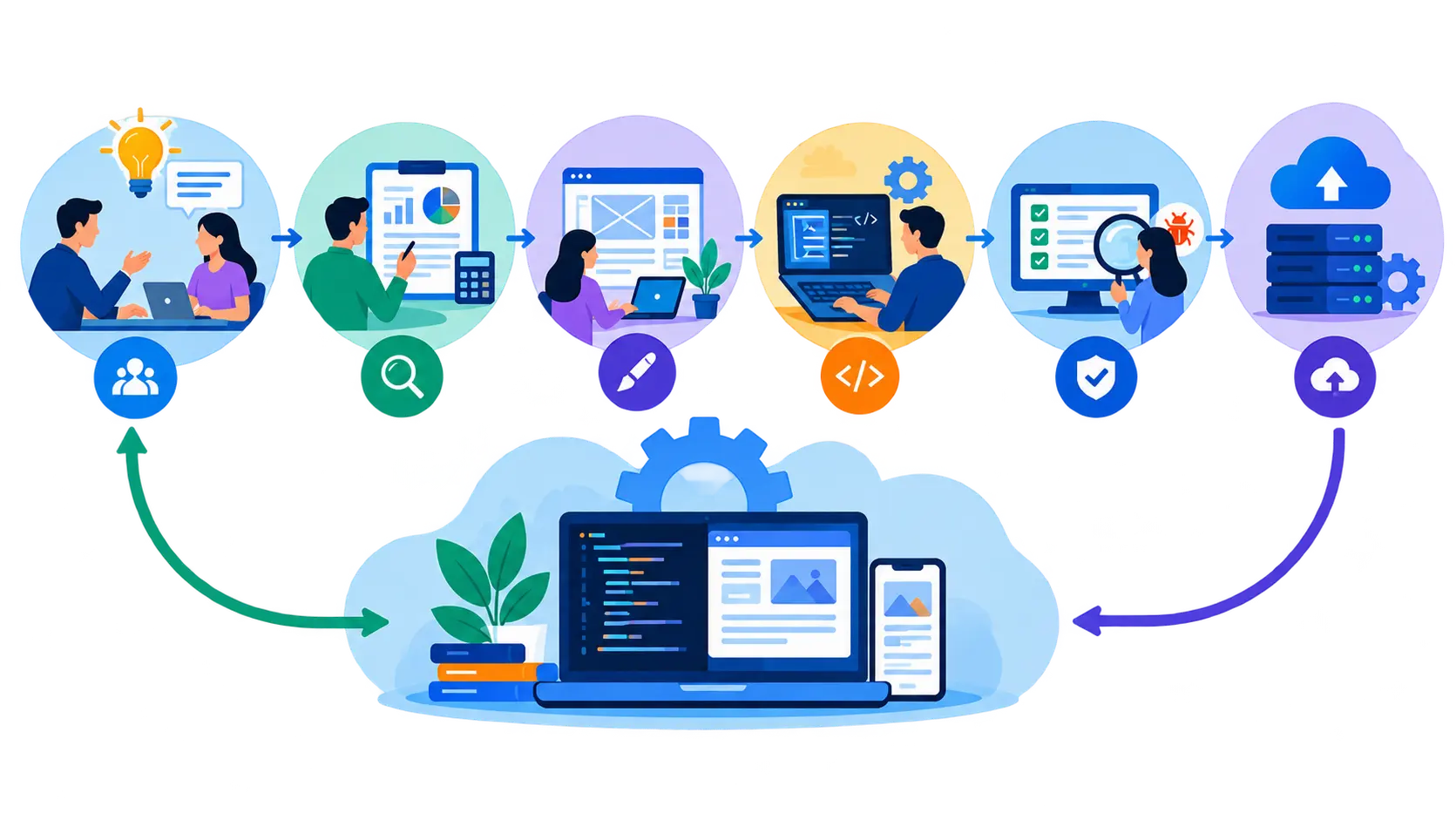
Different phases of SDLC
Primarily, there are 6 phases of the software development life cycle:
- Planning
- Defining / analysis
- Designing
- Coding/implementation
- Testing
- Deployment & maintenance
The planning phase
In this Phase, an open discussion happens between the service provider and the client about what the client wants in the application. After the client is done explaining his requirements and the time frame, the service provider tells him about the budget.
The defining & analysis phase
After the planning phase is done, the client’s requirements are then discussed with the team of the company. In this, a cost-effective model also known as COCOMO is used to estimate the cost, effort, and schedule for the project. After this is done and the cost is finalized with the team, it is then communicated to the client. And after all the negotiations are done regarding the price, time frame, and schedule are done, and they agree on the terms and conditions, A Software Requirements Specification document is prepared to start the project. This document actually specifies the working and the features of the software.
The designing phase
This is a phase in which the client is not involved. In this phase, Things like functions and modules, and the cohesion and coupling between them, are discussed. Also, a data flow diagram or a DFD is created. After this, it is then decided what the UI design of the application to be developed will be. Around 3 to 4 websites are given as examples so that the designer can understand properly. The Entity-Relationship Diagram is also built to proceed with the application development
The coding & implementation phase
After the design phase, the coding and implementation phase starts. In this, it is then determined what programming languages what frameworks, and databases are to be used. The service provider uses the latest technologies for the application.
The testing phase
After coding and implementation, the application cannot launch without testing. So, testing is done to catch the errors that appear while the software is running. There are different types of testing, such as system testing, alpha-beta testing, unit testing, integration testing, etc. There are also two types of approaches in testing, like white-box and black-box testing.
The deployment & maintenance phase
Then starts the deployment and maintenance phase. In this phase, the application that has been built, developed, and tested is then deployed on different environments in the cloud, like the dev environment, the testing environment, the pre-prod environment, and finally the production environment. Also, multiple demos are conducted for the client to display the capabilities of the software so that the client can understand the application completely. Also, a time window is given to the client by the service provider during which the client can ask for a change or an alteration in the application by paying a certain charge to the service provider
Why is SDLC that important?
The software development life cycle, or SDLC, is very important because it gives the developers and designers a clear idea of the things to keep in mind while building the software. Also, it gives the team an exact process to follow. It helps the developers to clearly understand what to do and what not to do. For example, the client wants an Online booking management system. The team might assume the client needs a system where users can book meetings and appointments. In contrast, the client meant he wanted a hotel booking management system with payment cancellation and availability management facilities. So, with the help of defining an analysis phase, it is clear to both parties what is to be built and what can be provided.
It controls time and cost. Software projects have limited money, developers, time, and infrastructure. So, before any project starts, the company will have to calculate the amount of effort it requires, the duration it will run for, and the actual price of it.
Every team is given a particular task to complete, and so it is responsible for the part that it is working on. Because of software project needs, designers, developers, database engineers, cloud DevOps specialists, testers, etc. This is the reason why SRS, DFDs, Database designs, and test cases are created.
Software quality improvement: A structured development process needs testing to be done around the designs and requirements
Large projects become manageable: Like if an enterprise resource planning software is being built, we can’t tell the team to build the entire ERP. We will have to clarify the client’s requirements, the features, the modules, the database to be used, the testing activities, and the releases
Different SDLC models
There are different SDLC models like:
- Waterfall model
- Agile model
- Spiral model
- V model
- Iterative model
- Incremental model
All these models and their importance are taught in software engineering.
Conclusion
The SDLC is a systematic approach that many custom software development companies use to avoid any kind of confusion, mistakes, or misunderstandings. It helps the company understand the client’s requirements, design, develop, test, deploy, and maintain the software they’ve created. SDLC also helps companies manage time, cost, quality requirements, and resources. Considering the nature and the requirements of the project, different SDLC models(Like waterfall, Agile, spiral, V model) can be selected to complete the project. Following this process, the design, development, testing, deployment, and maintenance of a project become easier. After the completion of the project, if the client wants a new feature or an extension, the team will be able to develop it with consummate ease and efficiency.