
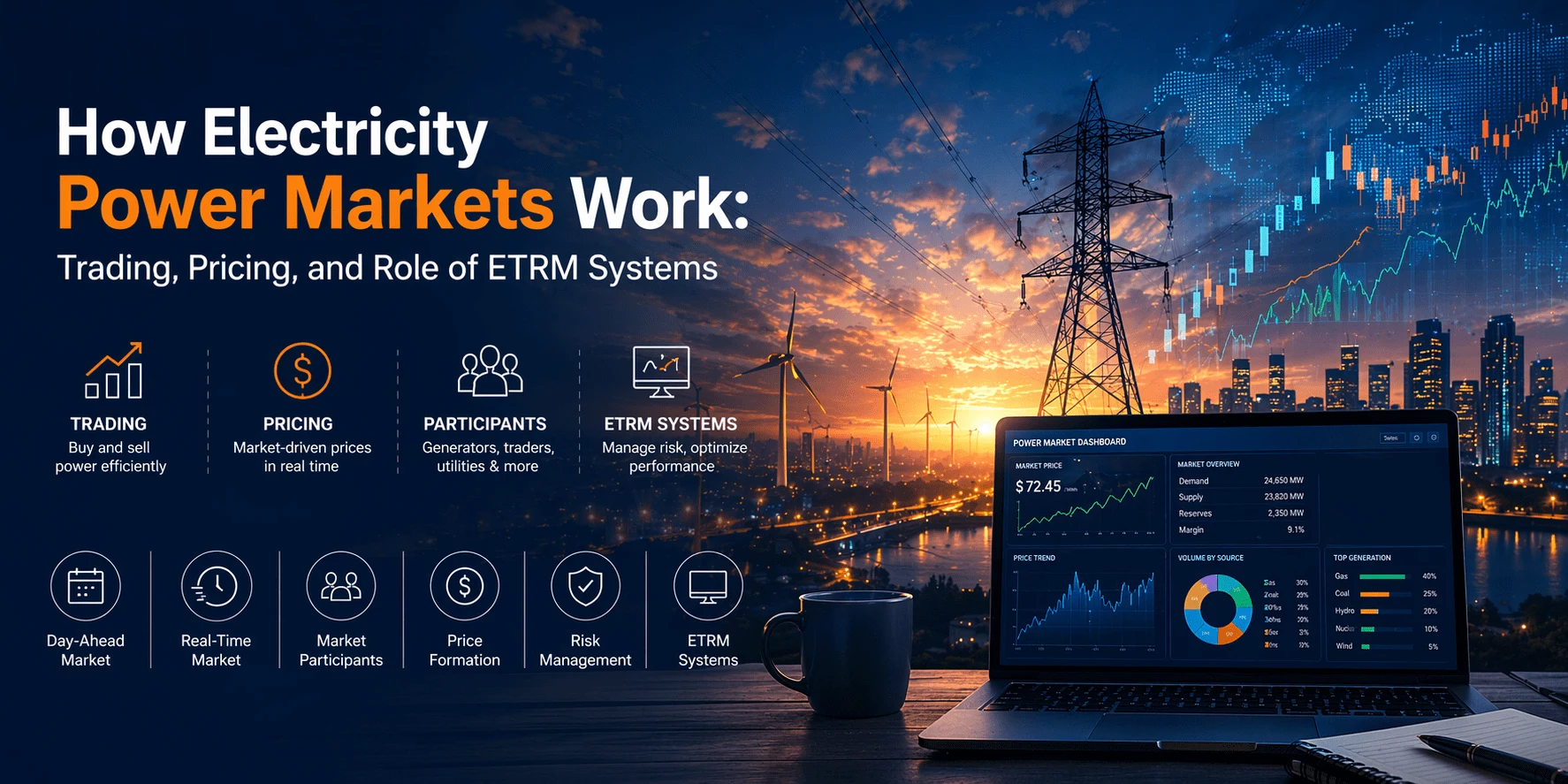
What is a Power Market for Electricity?
A power market for electricity is a market where electricity producers and consumers trade electricity. Unlike other goods that can be stored, electricity cannot be stored and, therefore, requires a more dynamic trading market than other products. Electricity power markets help balance supply and demand to avoid outages and ensure stable energy grids.
Power markets function based on exchanges or agreements between electricity sellers and buyers. The sellers put up offers of electricity while buyers make bids to purchase electricity. A market-clearing process occurs when supply and demand agree, ensuring price equilibrium. The power market needs to be technologically equipped to handle electricity since it is a commodity that should be used immediately after generation.
Deregulated power markets in contemporary economies give different firms a chance to participate in the market and compete.
How does Electricity Trading work?
Electricity trading is the exchange of electricity for use by consumers over a particular period. Traders use demand forecasts, weather predictions, fuel costs, and transmission details, among other factors, in making sound judgments. Transactions occur via exchanges or contracts between parties involved.
First, traders estimate the demand for electricity. For example, in hot seasons such as summer, demand for electricity rises due to cooling requirements. The generation companies place bids showing the quantity of electricity they generate, together with their cost. On the other hand, buyers will post their bids depending on their usage needs. This results in the formation of a market for electricity with a clearing price for each transaction.
Hedging is another activity undertaken by traders for the purpose of mitigating risk. Due to unpredictable fluctuations in electricity prices, traders need to hedge themselves from losses. Future and forward agreements offer protection from changes in prices.
Advanced technologies enable the trading of electricity to operate efficiently.
Types of Power Markets (Day Ahead Vs Real Time)
Electricity markets can be divided into two categories, namely day-ahead and real-time electricity markets. Each category plays a different role.
Firstly, the day-ahead electricity market enables traders to exchange electricity one day prior to the day when the electricity will be delivered. Traders make bids and offers on the basis of the forecasts of demand and generation capacity.
Secondly, the real-time market enables traders to adjust the balance of electricity delivery, and it operates within very short periods ranging from 5 to 15 minutes. The market is used to balance the deviations caused by unexpected weather conditions or technical breakdowns in production facilities.
As seen, both the day-ahead market and the real-time market have different functions.
Key Participants in Electricity Markets
The electricity markets include different parties that have their own roles within this complex network.
The role of generators is to produce electricity by using any means of energy production, like coal, gas, hydroelectric power stations, solar, and wind power plants. Utilities and retailers buy electricity from generators and sell it further to the consumers. Industrial consumers are also included among the buyers of electricity.
The transmission system operator oversees the process of transporting electricity to other regions through an efficient network. The market operator facilitates trading processes by conducting auctions. Traders also form part of the electricity market.
Regulators control all activities within the electricity market.
How Electricity Prices are Determined
Electricity prices depend on supply-demand dynamics; however, there are specific aspects that affect pricing.
The marginal price formation rule is one such aspect. The price at which electricity is traded in the market is defined based on the price of the most expensive producer used to cover all needs. For example, during periods of increased demand when cheap producers cannot generate electricity, a more expensive producer is used. This increases electricity prices.
Prices are also affected by climatic conditions. Warm or cold weather affects electricity demand. On the other hand, renewable energy is affected by sunshine and wind. The cost of fuel, such as gas and coal, will also determine prices.
Electricity prices can vary regionally due to grid bottlenecks. When transmission lines are congested, electricity becomes costly in the regions where transmission difficulties arise. Moreover, electricity pricing can also be affected by regulations, particularly carbon pricing policies.
Overall, electricity prices are very dynamic and change either hourly or minute-to-minute.
Challenges in Power Trading and Risk Management
There are various challenges associated with electricity trading due to its special character.
The first issue is related to price volatility. The prices may suddenly jump up due to changes in supply and demand, which makes it necessary to address risk management issues.
The second problem is connected with forecasting accuracy because it becomes increasingly harder to predict electricity demand or generation by renewable sources, depending on weather conditions.
Market players should be aware of different operational risks, including power outages, technical breakdowns, or other unforeseeable circumstances.
Renewable energy sources are also challenging for electricity trading because their use makes the process more unpredictable.
How companies use ETRM for power trading operations
Power trading companies have to make use of special software tools that assist them in conducting their operations effectively. In particular, such tools facilitate tracking of transactions, risk management, and regulatory compliance.
With the help of this tool, it becomes possible for companies to conduct real-time data analysis, which makes it easier for traders to make well-informed decisions about how to trade energy. The other functionality of this software tool includes contract management, scheduling, and settlement.
One of the most important capabilities offered by ETRM systems to companies is risk management. With this capability, companies are able to assess their risks in terms of market, credit, and operational aspects.
Besides, with the help of the ETRM system integration with various market sources and the grid system, it is possible to get a full view of all trading activities, allowing one to act promptly in changing situations.
Strong knowledge of systems is crucial for professionals in this field.
Skills required for working in Power Trading
Working in power trading markets involves having various sets of skills, such as technical, analytical, and industry-specific skills.
Firstly, it is important to know the market basics, including supply and demand forces and pricing systems. Second is the need for analytical skills to make trading decisions.
It is also advantageous to possess technical skills, including the ability to use specific software and programming languages.
Moreover, other skills, such as communication skills, are necessary in situations involving quick decision-making.
Understanding energy trading and risk management concepts would be helpful for individuals planning to enter this industry.
How to start a career in Energy Trading Systems
If one wants to enter the sphere of electricity trading systems, he or she needs to have a comprehensive strategy.
The first stage may include gaining adequate education in such spheres as finance, engineering, energy studies, or economics. The comprehension of how electricity trading markets operate and knowledge of their trading basics may turn out to be quite useful.
Another good opportunity to participate in electricity trading systems would be internships and employment positions in the energy sector. One more step that can be taken while developing one’s career in this sphere is attending special training programs. For example, one might consider gaining experience with industry-standard platforms used in energy trading that provide valuable skills.