
The energy sector is one of the most rapidly developing areas of the world’s economy. One of its key aspects is oil and gas trading. This process is characterized by multiple stages, each of which requires special pricing schemes and innovative technologies. It is extremely important for individuals planning to enter this field to understand this process and its features.
This article offers detailed information regarding the fundamental aspects of supply chains, pricing schemes, and modern technologies used in this process.
What is Oil and Gas Trading?
Oil and gas Trading is an industry in which crude oil, natural gas, and various petroleum products are traded within national and international markets. In this trade, physical and financial methods are employed for transactions and dealings.
The essence of oil and gas trading centers on the linkages among various actors in the process. The activities of traders involve earning profits from differences in pricing while mitigating risks through consistent trading.
The operations involve negotiations on different contracts, analysis of supply and demand situations, and taking into consideration various factors that change on the ground. Such trade requires advanced skills in market research as well as access to current information.
Trade in oil and gas requires certain decision-making strategies based on the analysis of trends in the market, storage capacities, and transport logistics.
Understanding the Oil and Gas Supply Chain
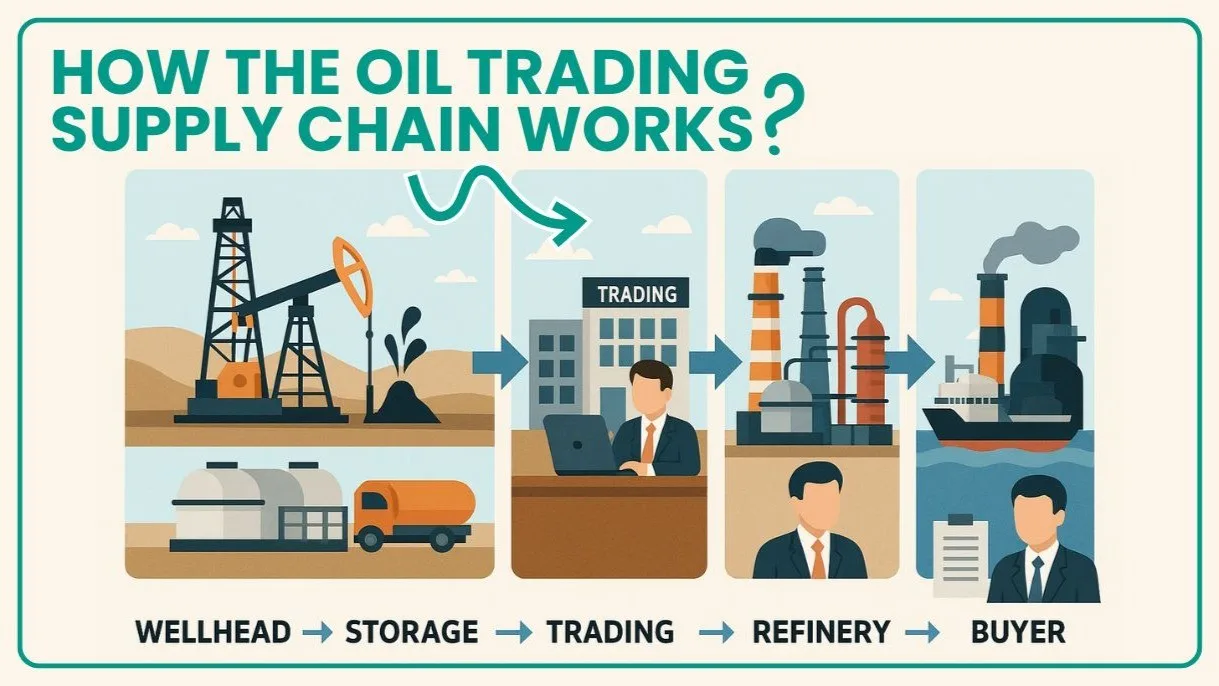
The oil and gas supply chain could be viewed as a complex chain of events that converts crude oil and natural gas into useful sources of energy. This chain could be divided into three main processes, namely:
Upstream – the extraction process of crude oil and natural gas
Midstream – the distribution of crude oil through pipelines, tankers, and terminals
Downstream – the conversion of crude oil into various types of fuels such as gasoline and kerosene
All of these processes must run effectively.
Pricing and availability of crude oil and natural gas depend on the efficiency of the supply chain.
How Pricing Works in Oil and Gas Price Markets
The mechanism of pricing in the oil and gas market sector is determined by numerous factors. In this regard, it should be noted that oil price volatility is one of the crucial aspects since prices can fluctuate depending on various internal and external factors.
Crude Oil Benchmark Prices
The world is led by two main oil benchmarks:
- Brent Crude: It serves as a benchmark for international prices in Europe and Asia.
- WTI (West Texas Intermediate): The oil type mainly used in the USA.
The trading process includes both spot markets and futures contracts on exchanges. To estimate the possible price changes, traders focus on inventories, output restrictions (as in the case of OPEC), and overall global demand.
Exchange Rates, Weather, and Technology
The other crucial factors include exchange rates, weather, and technology innovations. The strengthening of the US dollar generally reduces the price of oil since the commodity is priced in dollars.
Challenges in Oil and Gas Trading Operations
There are various challenges involved in doing business in the oil and gas market, and these need to be addressed by the traders for them to be able to operate effectively in the market.
Firstly, there is always an element of risk when it comes to doing business in the oil and gas market, and traders have to employ hedging and derivative techniques to minimize these risks.
Secondly, logistics is another important issue that needs to be considered, as the transportation of crude oil and natural gas is very complex and involves huge amounts of money.
Lastly, compliance issues are very crucial when doing business in the oil and gas market.
Role of Energy Trading Systems in Oil & Gas
There has been much change in the way energy trading is done owing to the presence of technology. In today’s world, energy trading systems have become very important because of the complexities in the market.
Through them, the traders can keep track of their contracts, the market information, risk management, and other related aspects all at the same time. These systems are known to integrate capabilities such as contract management, scheduling, settlement, and reporting. Modern energy trading systems help organizations streamline operations and manage risk efficiently.
Energy trading, which is practiced by the oil and gas organizations today, demands that energy systems be used for handling the contracts and risks along with market information.
Skills Required for Oil and Gas Trading Systems
In order to succeed in the trading system for oil and gas, there are several skill sets that need to be present.
Firstly, analytical skills are needed to assist in the analysis of trends within the market and the prediction of future changes based on current information.
Software understanding is also critical, especially with today’s advancements, where most things are computerized. It would be advantageous to know how trading systems work, together with other forms of enterprise software.
Market knowledge is also very crucial, since there are many factors that may impact prices. Other skills could also prove to be useful.
How to Start a Career in Energy Trading Systems
One may start a career in such an area, combining learning and acquiring practical experience.
Knowledge in the sphere of finance, economics, engineering, or energy studies may serve as a good starting point. Many individuals prefer to gain some certification or training in such areas as trading systems and risk management.
Interning at energy companies, trading companies, or financial firms, individuals may get some valuable experience in working with trading platforms. This may be very helpful when considering further steps in one’s career path.
In addition to that, networking may prove to be quite productive in gaining new positions and skills. Since the development of technologies plays a crucial role in the energy trading sphere, becoming well-versed in them will undoubtedly be advantageous for candidates.
It should be said that taking an interest in the position related to energy systems, especially oil and gas, may serve as a basis for successful career development.
Conclusion:
The oil and gas trading world is a fast-moving one that is very much tied up with global economic systems and structures. From the complex nature of the oil and gas value chains to the volatile nature of prices and the use of technology, everything about the oil and gas industry contributes in its own way.
With the changing dynamics in today’s markets, the role played by technologies such as energy trading platforms will only increase further.
For those who are considering this sector as a possible career, it would be an added advantage to have at least an idea of the fundamentals of oil and gas.