
Introduction: Why IIoT budgets go wrong
In this article, we will be discussing the costs of an industrial IoT product, what components are used in it, what the costs are for all of them, and its creation and deployment. In an IoT product, the sensor is usually the cheapest part, but at that time you are not aware of the underlying costs. The real bill mostly consists of connectivity plans, cloud storage, integration work, and the time taken to install the equipment. Most companies that provide IoT development services don’t account for the underlying costs of design, development, implementation, and testing when approving a budget; they focus only on hardware costs.
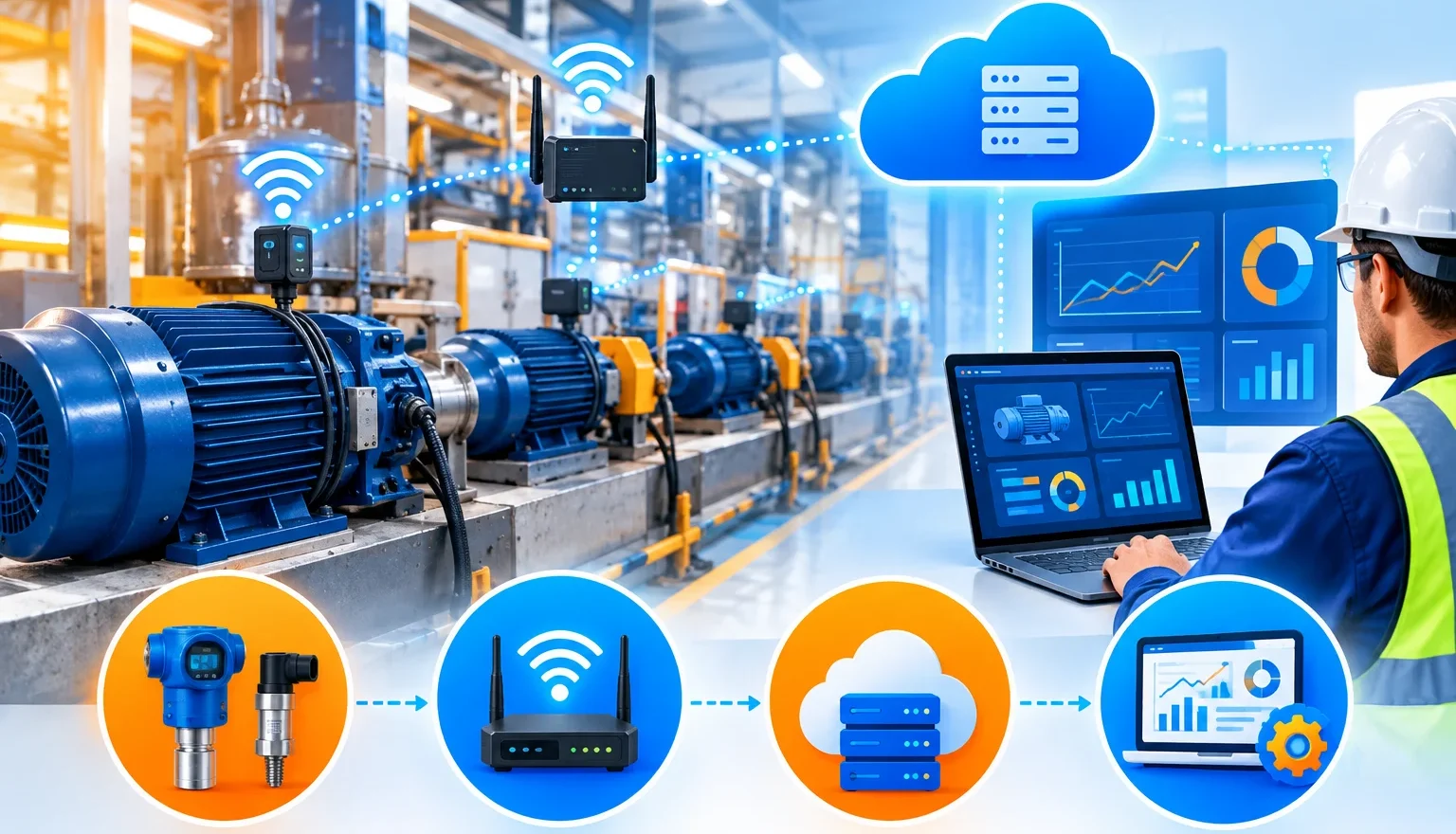
What drives the cost of an Industrial IoT project
Most industrial IoT projects are never a single purchase. It is actually a chain of linked layers (devices, network, software, and people). The final cost depends on how many layers you build and how complex each is. Two or more plants with the same number of machines can definitely end up with different budgets because of the factors written below:
The number of assets being monitored: The more devices, lines, and software you connect, the higher the hardware cost will be, and the more the installation and configuration costs will increase.
Age and condition of the existing devices: The devices or machines that are newly developed usually have open ports and protocols (OPC UA and Modbus). Whereas in the older machines, you may need to retrofit the sensors in other parts.
Data volume and frequency: The more data you collect, the more the storage devices’ connectivity and processing costs will be impacted.
Site condition and environment: The weather conditions also decide what type of equipment needs to be used in the IIoT project. Dust, heat, and moisture will make you use industrial-grade equipment instead of the commercial-grade equivalents.
Cloud, edge, or on-premises architecture: When everything is handled by the cloud, the upfront fees are usually low, but as the resource usage increases, the costs also increase. Edge and on-premises architecture cost more initially because you have to pay for the hardware, but they reduce bandwidth and latency.
Sensors and Edge hardware
This layer in an IIoT project matters a lot because, while planning an IIoT budget, sensors and edge hardware usually come first in the visible line. Good capital is needed to arrange them, but sensors are also the cheapest part, while the deployment is being done. The cables and power supply, installation labor, and configuration usually double or triple the cost of the device.
Sensor types and selection are also a very crucial part. While basic sensors like temperature, humidity, pressure, and current are not that expensive, the industrial-grade components are really very expensive. But more sensors do not always mean better insight; if the sensor is placed at the correct point, the data volume stays lower, and the cloud costs do too.
There is a big difference between the industrial-grade and the commercial-grade hardware. When the developer thinks of developing an IIoT device they think about hobbyist boards like Raspberry Pi and Arduino while they are not aware of the hidden costs and they’re also not aware of the efficiency and fault tolerance of commercial-grade hardware like ESP32. While these hobbyist boards are good for learning how to develop, they are definitely not good for creating an IIoT product because industrial-grade hardware has high fault tolerance and is built for wide temperature ranges, vibration, dust, moisture, and electrical noise as well. Cheap commercial-grade hardware is good for proof of concept.
The cost of cloud and data platform
After the hardware part development is done, the focus then shifts to the cloud cost. Because hardware is only a one-time purchase, but cloud bills arrive every month. That cloud bill increases as you increase the number of users and the data.
Data ingestion: Getting data from your devices to the cloud costs money. Platforms like AWS and Azure usually charge per message, per connected device, and per tier. The number of samples matters a lot in data, and when a Sensor takes a reading and transmits it to the cloud every second, the resources are used more. So, sampling rate is also a challenge in the ingestion cost.
Storage: Industrial data: This is really volumetric. A lot of data is accumulated in very little time, so it needs different storage than simple business data. There are usually two types: hot storage and warm/cold storage. The new data is kept in fast databases like InfluxDB or managed cloud equivalents for live updates and dashboards, which is very expensive, whereas the older data is moved to cheaper storage for audits and model training in the future. When you want to cut down the costs, you must release the raw data, which will cut down the storage costs. Also, getting data out of one cloud provider and migrating it to another costs money.
Processing and analytics: Stream processing real-time rules and alerts runs continuously, and they cost money. Instructions that run concurrently and simultaneously stop also cost a lot. And when machine learning is also involved in your IIoT project, then it also adds up model training costs.
| Option | Upfront cost | Ongoing cost | Best for |
|---|---|---|---|
| Custom platform on a cloud provider | Higher | Pay for usage and maintenance | Unique requirements; good for long-term control |
| Off-the-shelf IIoT platform (e.g. ThingWorx) | Lower | Subscription and license fees increase the devices | Faster rollout, standard use cases |
| Hybrid or open source (e.g. ThingsBoard) | Moderate | Lower initial licensing cost | Cost-conscious teams |
Deployment and installation charges
Deployment and installation charges are the most underestimated costs because most buyers usually focus on the price of sensors and the cloud platform. Deployment is where the hidden charges are exposed. Deployment is usually dependent on site survey and planning. Every deployment starts with a site survey. The site survey is done to analyze the environmental conditions such as heat, dust, vibration, moisture, and hazardous zones. This is very helpful in determining the grid of the equipment to be used. The survey also helps identify which machines have accessible data and which will need retrofit sensors. Physical installation needs cables running power and network access points, so these increase the costs. The training, testing, and maintenance of the IIoT product device also take time and money.
How to measure the return on investment of an Industrial IoT Project
The ROI in an IIoT project can only be measured against something. Before thinking about sensors, we have to take into account the record of the current numbers: the downtime hours per month, the maintenance cost per asset, and the time operators spend on manual readings and reporting. So the return on investment is actually the net benefit divided by the total cost, expressed as a percentage.
Conclusion
An industrial IoT project costs much more than the sensors; money is paid for connectivity, cloud, and data platform, as well as integration with other existing platforms, solution testing, and years of maintenance. To plan your next industrial IoT project with Intellimachs, book a call with us.