
As more and more devices are becoming smarter, automations and interconnected systems are increasingly becoming an integral part of technology. In such situations, microcontrollers play an important role in helping users achieve their objectives. One of the best options today when it comes to powerful and cost-effective microcontrollers is ESP32, which is used both by amateurs trying their hand at IoT applications and professionals who wish to create complex IoT applications.
In this article, we will discuss what ESP32 is, its characteristics, architecture, applications, and how it is better than alternatives.
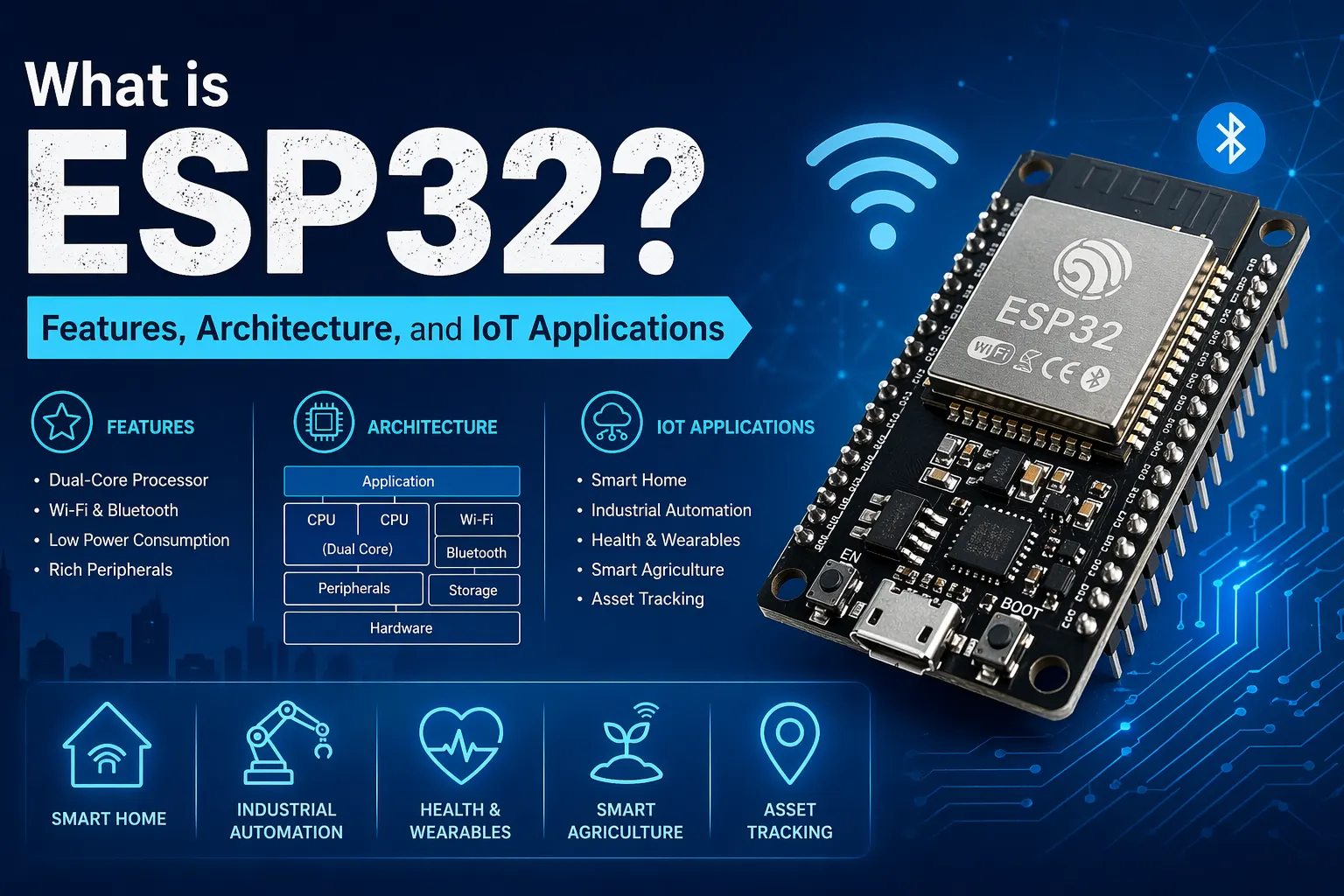
What is the ESP32?
When wondering about the ESP32 definition, the ESP32 microcontroller is considered one of the most economical models of ESP32 that have been designed to enable connectivity and control within many smart devices. It is a microcontroller manufactured by Espressif Systems.
The ESP32 could be referred to as a combination of both the ESP32 WiFi module and the ESP32 Bluetooth module. The ESP32 allows you to develop any smart device using no additional modules. This includes such options as:
- Smart Home devices
- Wearables
- Industrial automation system
- Remote monitoring solutions
Due to its economical cost and high connectivity capabilities, ESP32 is widely utilized in IoT solutions.
Key Features of ESP32
An understanding of key ESP32 features can help us to understand why ESP32 is popular in the Internet of Things world.
Dual-Core Processor
It features two cores from the same Tensilica processor family, which enables it to execute many tasks at once.
WiFi and BLE Connectivity
Among the essential features is WiFi+BLE capability. This way, there will be no need for any extra module, and you won’t have to complicate your hardware design when developing IoT with ESP32.
Low Power consumption
ESP32 has been built to save energy. There are several power-saving modes for ESP32 to use, which is great for battery-powered gadgets like sensors and wearables.
GPIOs Pins
Features of ESP32 multiple GPIOs, which enable connecting sensors, actuators, displays, and other hardware easily.
Additional Features
- Touch sensing
- DAC/ADC capabilities
- PWM management
- Encryption for security and much more
All of these make the ESP32 perfect for any ESP32 IoT projects, either for beginners or professionals.
ESP32 Architecture Overview
To gain a thorough understanding of what ESP32 can offer, let us consider its architecture.
CPU and Memory
ESP32 is powered by a two-core processor that works at frequencies up to 240 MHz; it also possesses the following memory modules:
- SRAM for fast computations;
- Flash for storing data
- ROM to carry out booting tasks.
Such an architectural design allows the ESP32 microcontroller to cope with complex computations.
Connectivity Modules
The following types of chips are embedded:
- WiFi (IEEE 802.11b/g/n);
- Bluetooth Classic
- Bluetooth Low Energy (BLE).
Thus, ESP32 becomes an all-round ESP32 WiFi Bluetooth module.
Peripherals
ESP32 is provided with lots of peripherals, such as:
- SPI, I2C, UART
- ADC and DAC
- PWM channels
- Capacitive touch inputs
Why ESP32 is Popular in IOT Development
There are several reasons why the IoT Development using ESP32 has been popular among developers who utilize ESP32 for IoT.
Cost-effective solution
ESP32 provides exceptional performance characteristics at an affordable price point. Thus, it can be used by startups, hobbyists, and large-scale IoT service providers.
Easy Integration
ESP32 integrates seamlessly into the project due to its integrated connectivity features and extensive library. Additionally, it works perfectly with widely used software development environments such as Arduino and MicroPython.
Strong Community support
ESP32 has an enormous developer community, which means that developers can find tutorials, libraries, and other helpful information quickly to expedite their development work.
Multiple IoT companies in India offering solutions to IoT have made the most out of ESP32 by scaling up their operations and saving on costs.
Real-world Applications of ESP32 in IoT
ESP32 is very versatile in nature, and thus, it can be applied in numerous ways. Some of the ESP32 applications are as follows:
Smart Home
ESP32 can be used in various ways in home automation, such as:
- Smart lighting
- Smart thermostats
- Voice-activated appliances
Through the WiFi and Bluetooth functionality of ESP32, devices can be controlled remotely.
Industrial Automation
In industries, ESP32 can be used for:
- Machine monitoring
- Predictive Maintenance
- Energy Management
Usage of ESP32 in this way has made it very crucial for Industrial IoT solutions.
Healthcare Devices
Some of the uses of ESP32 include:
- Heart rate monitors
- Patient tracking systems
- Smart health devices
- It provides good battery life because of its reduced power usage.
Logistics Tracking
ESP32 can be used in fleet management, supply chain tracking, and asset monitoring using GPS-based technologies.
The uses of ESP32 mentioned above are highly useful for logistics.
Overall, ESP32 has played an important role in the evolution of ESP32 IoT applications.
ESP 32 Vs Arduino Vs Raspberry Pi
| Feature | ESP32 | Arduino (Uno) | Raspberry Pi |
| Type | Microcontroller | Microcontroller | Microprocessor |
| Connectivity | Wif+ bluetooth | None (External Needed) | Wif+ bluetooth |
| Processing Power | High | Low | Very high |
| Cost | Low | Low | Moderate |
| Power consumption | Low | Very Low | High |
| Best Use | IOT Projects | Simple electronics | Full Computing Tasks |
Comparison of ESP32 with Arduino
When comparing ESP32 with Arduino, ESP32 has an upper hand due to its superior performance and built-in connectivity, making it the most suitable for IoT applications.
Comparison of ESP32 with Raspberry Pi
Although Raspberry Pi has higher performance, it has high energy consumption levels, making it less suitable for IoT applications.
Getting Started with ESP32
For beginners, starting with ESP32 is much easier than anticipated.
Tools Required
- ESP32 development board
- USB cable
- Computer
IDE Options
Some IDEs for programming ESP32 include:
- Arduino IDE
- PlatformIO
- MicroPython
Steps for Beginners
- Install Arduino IDE
- Add the ESP32 board support
- Plug the ESP32 board into the computer using a USB cable
- Program the ESP32 board using the “Blink” code
- Play around with the ESP32’s WiFi capabilities
Now that you are familiar with ESP32 programming basics, you are ready to develop more complex ESP32-based IoT applications.
Conclusion:
The introduction of ESP32 has brought about a revolution in the way IoT-based systems are designed. The sophisticated processing power, connectivity options, and affordability of ESP32 make it an essential component in any IoT-based system.
ESP32 has made waves in several industries due to its flexibility and scalability. It will play an important part in the future of IoT-based systems.
Without a doubt, ESP32 will be the preferred choice of many new IoT development companies in India.