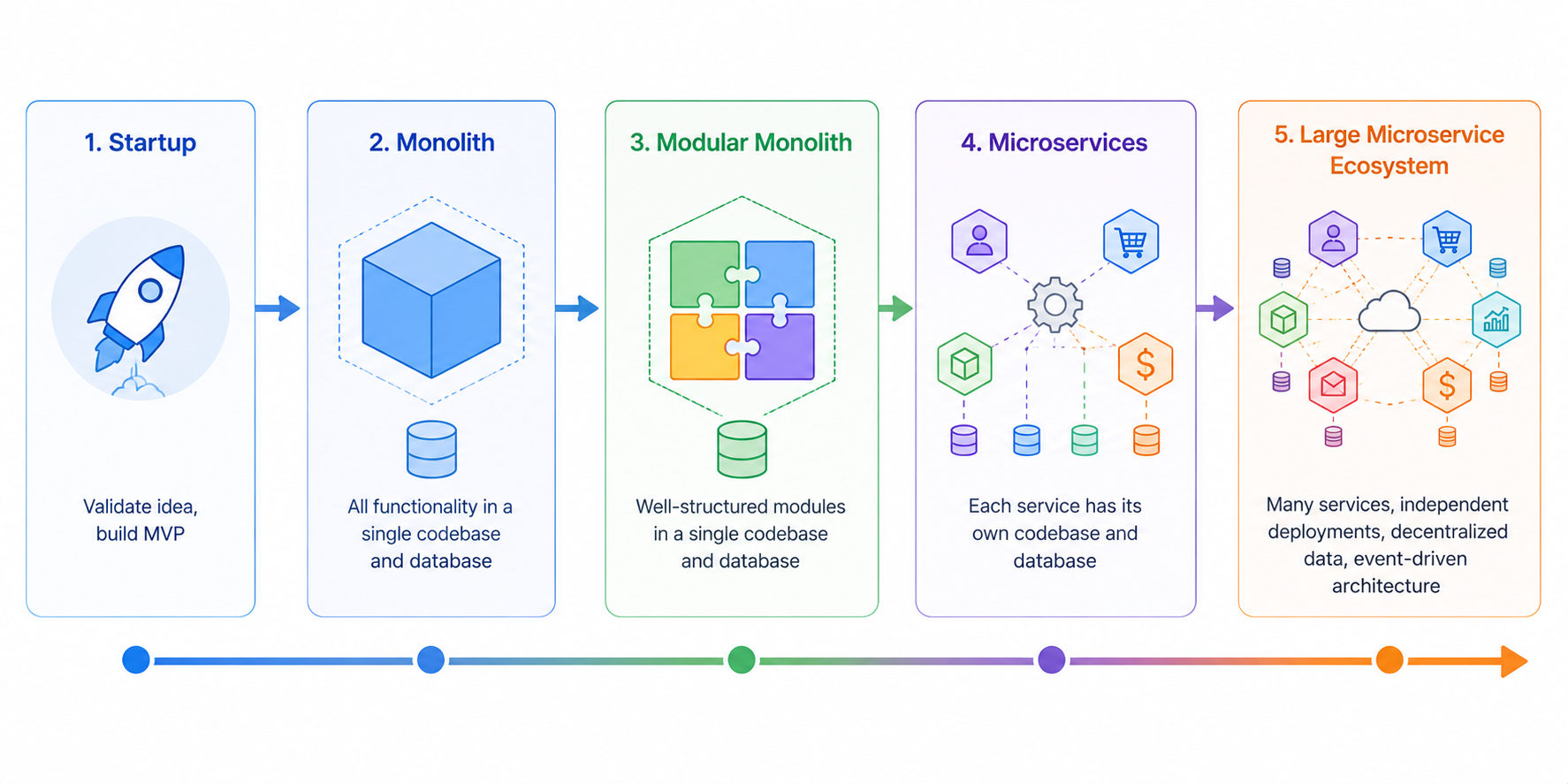
Monolithic vs Microservice architecture? Which is Better
In the IT Industry, there are two primary ways companies build software applications: monolithic architecture and microservice architecture. In this post, we are going to discuss the insights of both types of architectures in detail.

What is Monolithic architecture?
When a software application is built, it obviously contains multiple components and modules. When those components and modules are built into one single program or project, the architecture is known as monolithic. For example, an Edtech solution is being made, so different types of services are needed for the solution to function properly, like a user authentication service (which handles login, registration, etc), a course management service (which handles course creation, video uploads, etc), and a payment service (which handles subscriptions). All these modules are in a single project, which makes it very heavy, especially as the project grows and more APIs need to be integrated. In this type of project, the communication between the modules is simple via a common file or simply methods and functions. Every module resides in a separate folder, and no Dockerization or containerization is required in this kind of project.
Benefits of monolithic architecture:
- Simpler development, everything exists in a single codebase: frontend, backend, business logic, etc.
- Easier deployment, single service instead of multiple APIs and API gateways.
- Faster development speed, developers can directly call functions, and modules can be debugged and tested easily
- Lower infrastructure costs, monolithic apps can be deployed on one server, and a single server deployment pipeline
Disadvantages of monolithic architecture:
- Limitations in scalability, if a service needs more resources, like the payment service, the entire application will have to scale up, instead of scaling up only that one particular service.
- Larger codebase over time, as new services or requirements come, the codebase will grow, and it will become very hard to manage.
- Slow deployment is for very large systems; if a particular service is changed, the entire application will need to be rebuilt, retested, and deployed.
- One memory leak or a faulty module can crash the entire application at the production level
Do Software companies still use monolithic architecture?
Yes, many enterprise software development companies still prefer monolithic architecture in some situations, like small to mid-sized business applications, for eg, ERP Systems, internal dashboards, and CRM platforms. These apps are still built as modular monoliths because they need to be developed quickly, simpler deployment is needed, and lower infrastructure costs.
What is Microservice architecture?
A project that is built with a microservice architecture has different services as different projects that communicate via a common API Gateway or distributed event streaming platforms like Apache Kafka and AutoMQ. For eg, an e-commerce platform is being built, now it will have many modules like Product service, Cart service, Order service, Payment service, and so on. Now, each of these services will be built separately as a project, and all these services will communicate via an api gateway or event distribution systems like Apache Kafka.
After a service is built and tested, that service is packaged into a Docker image and then pushed into a git repository. After the code is committed, built, and tested, and the Docker build is done, it is finally deployed with the help of tools like Jenkins, GitHub Actions, etc.
In case the traffic to one particular service increases, then scaling is needed, and then that particular service is Dockerized and sent to the Kubernetes cluster, so that, let’s say, if currently 3 pods are running the product service and suddenly too many requests arrive on the product service api, Kubernetes will automatically increase the number of pods running the product service only and the rest of the pods that were running other services will remain the same in number.
Benefits of microservice architecture:
- Independent deployment: if a particular service needs to be changed, the developer won’t need the entire e-commerce project; he can pull that service from the repository to alter it and then redeploy it, everything else remains untouched.
- Technology flexibility: different services could use different technologies. For eg, the user service (that contains the authentication module, etc.) is built with Java Spring Boot, and the product service is built with Node.js and Express. Both services can communicate easily.
- Better team ownership: like there are 4 different services: User, Product, Cart, and Payment service, and there are 4 development teams, A, B, C, and D. So all 4 teams can work in parallel and independently with their own technical expertise and frameworks (e.g., Spring Boot, Node.js, ASP.NET, etc) on each of the services.
- Fault isolation: Suppose a particular service crashes; it won’t impact the other running services at all.
- Easier replacement of components if needed, for efficiency and speed.
Disadvantages of microservice architecture:
- Increased complexity: instead of a single codebase, I have multiple codebases, repositories for different services.
- Network calls are much slower than function/method calls in monolithic applications.
- Monitoring and observatory requirements: monoliths have one log file usually, but microservice applications generate logs from many services. Common tools like Prometheus, Grafana, and Elastic Stack.
- Infrastructure costs are greater in microservices-based applications because there are multiple containers for different services, whereas a monolith can run on one server.
- Distributed transactions.
Final Conclusion
As discussed above, there is no necessity for any kind of architecture. It all depends on the current business problem. When a project is to be built by a startup with a small team, say 1-10 developers with limited DevOps exposure and a limited budget, then monolithic architecture is preferred. Advantages of that would be: rapid development, easier debugging, simpler testing, etc.
When we have multiple development teams that have expertise in different technologies and frameworks, and very mature DevOps knowledge, and different scaling requirements, and more frequent deployments, then in that scenario, microservice architecture is preferred. Many IT Consulting Services prefer microservice architecture. Advantages of that would be: parallel deployments, better fault isolation, team autonomy, large-scale growth, etc.
Very, very few companies started with microservices, like Amazon, Netflix, Uber, etc.
An early-phase startup may start with a monolithic architecture and later migrate to a microservice-based architecture.